


Everyone knows about the chips. Fewer investors are looking at the power, cooling and property that every AI system needs to run, and that's where some of the tightest bottlenecks now sit.
For years, data centres were the dull grey sheds of the internet. They stored our emails and streamed our shows, and investors barely gave them a thought.
AI changed that. A single large AI data centre can now use as much electricity as 100,000 homes, which is roughly a city the size of Hobart. Building, powering and cooling these sites has become one of the biggest construction efforts in history.
A spending boom with few precedents
The tech giants (Microsoft, Amazon, Google, Meta and Oracle) are now spending more than US$900 billion a year on AI infrastructure. Measured against the size of the US economy, that's more than the Apollo moon program, the Manhattan Project and the interstate highway system combined, at their peaks.
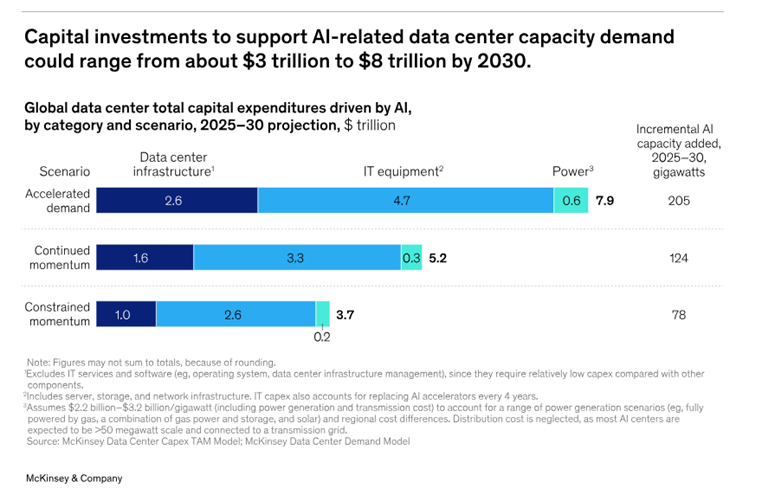
It isn't slowing down. Global data centres run on about 100 gigawatts of power today, more than Australia's entire grid. By 2030 they could need 250 gigawatts. That's like building two or three more Australias' worth of electricity supply. McKinsey estimates AI-driven data centre investment could total between US$3 trillion and US$8 trillion from 2025 to 2030.
Why this matters for investors
The link is simple: one company's spending is another company's revenue. Every dollar the tech giants put into data centres ends up as sales for the businesses that supply them.
Right now, demand is running well ahead of supply. Waiting lists for gas turbines stretch past five years, and skilled trades such as welders are in short supply. When customers are queuing, suppliers can raise their prices. Rising sales at higher prices mean fatter profits, and over time, growing profits are what drive share prices and dividends.
The half of the AI story most investors miss
About half of every AI dollar goes to chipmakers like Nvidia. The market knows this well: chip stocks now make up nearly 15% of the S&P 500.
The other half goes into the physical world: power equipment, cooling systems, buildings and land. These businesses get far less attention.
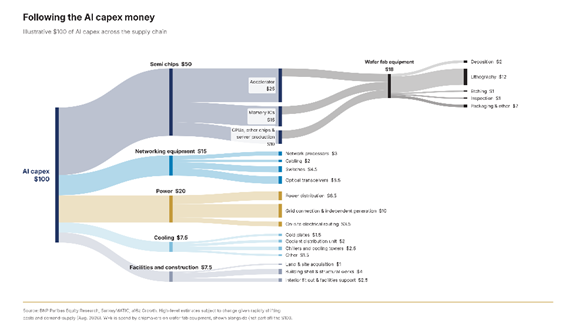
Power. About 20 cents of every AI dollar goes on power. The tech giants' electricity use has grown about 23% a year this decade, while overall US power demand barely moved between 2006 and 2024. Grid connections are taking longer and longer, and everyone is trying to buy generators, transformers and switchgear from the same handful of suppliers. Microsoft boss Satya Nadella has even warned of expensive chips sitting idle because there's no power to plug them into. For the makers of that equipment, desperate trillion-dollar customers mean strong pricing power.
Cooling. AI chips run so hot that blowing cold air over them no longer works, so new data centres need liquid cooling and complex plumbing. Cooling has jumped from about 5% of a data centre's construction budget to nearly 20%. Specialists such as Vertiv sell the equipment and then get paid to service it for years.
Property. Data centres aren't cheap sheds on cheap land. Before a single chip goes in, the building, wiring and plumbing cost US$12–20 million per megawatt, so a large site can run to US$5–10 billion. Location matters too. Most AI use in future will be answering questions in real time, which needs responses in under 20 milliseconds, so sites must sit close to cities, where land with strong grid access is scarce. US spending on data centre construction has now overtaken office construction for the first time. Landlords such as Equinix and Digital Realty are listed as REITs (real estate investment trusts), which own property and pass most of the rent to investors.
What could go wrong
No boom is guaranteed. If AI doesn't earn enough money for the tech giants, they could cut their spending. Power shortages and planning delays could slow construction. Many of these stocks already price in strong growth, which leaves less room for disappointment. A fund focused on one theme is also more concentrated, and usually more volatile, than a broad share market fund.
One way to get access
The ETFS Global AI Infrastructure and Data Centres ETF (ASX: DTCR) is Australia's first data centre ETF. In a single trade on the ASX, it gives investors exposure to the landlords, power specialists and cooling engineers building the physical backbone of AI. Like any thematic investment, it's best considered as one part of a diversified portfolio.
Disclaimer: ETF Shares Management Limited (ACN: 680 639 963) (AFSL: 562 766), is the Responsible Entity and issuer of the ETFS Global AI Infrastructure and Data Centres ETF (ARSN: 700 102 030)
This release contains general information only and does not take into account any person's objectives, financial situation or needs. Investors should read the Product Disclosure Statement and Target Market Determination, available at www.etfshares.com.au, and consider seeking professional advice before investing. Past performance is not a reliable indicator of future performance.